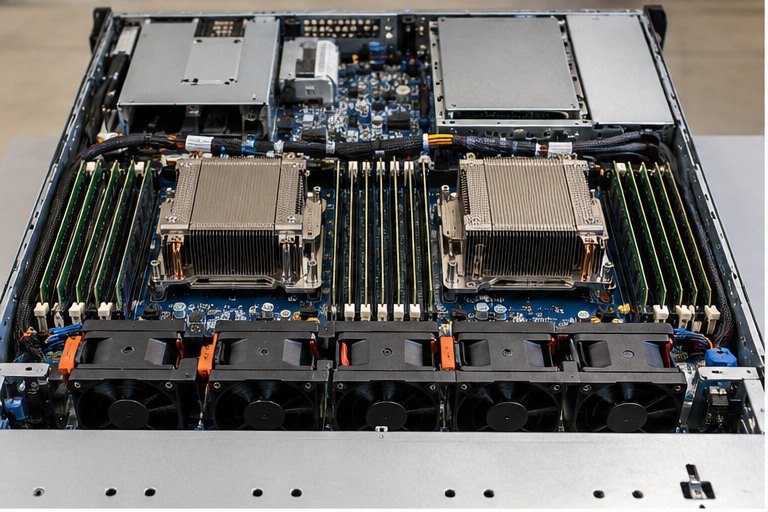
Use the exact server model, generation and manufacturer documentation before ordering or replacing a component. Similar appearance, wattage, connector or form factor does not prove compatibility.
1. 1U, 2U, 3U and 4U describe height
Rack unit height describes vertical rack space. It does not tell you server depth, weight, rail type, rear clearance or whether the equipment will fit a particular cabinet.
2. Depth is often the real fit problem
Measure usable rail-to-rail depth and check the rail kit adjustment range, server chassis depth, cable-management arm clearance and rear cable bend space. Cabinet outside depth is not the same as usable equipment depth.
3. Rails are model-specific
Sliding and static rails can use different attachment mechanisms. Some are tool-less; some use screws or cage nuts. Do not assume a rail kit fits because the server width and U height look correct.
4. Cage nuts are not used for every rail
Square-hole racks commonly accept cage nuts for equipment that requires threaded mounting points, but many modern server rail kits latch directly into square holes. Follow the rail kit instructions.
5. Shelves are for equipment that cannot rail-mount
Check shelf depth, support method, load rating and cabinet fit. A front-mounted cantilever shelf and a four-post fixed shelf do not carry loads in the same way.
6. Installation acceptance
- Correct U position on both front and rear rails.
- Rails level and fully latched/fastened.
- Server weight supported by the intended rail system.
- Rear power and data cables have service clearance.
- Airflow is not obstructed.
- Rack stability and loading remain acceptable.
HARDWARE FOR THIS TOPIC